2026
SoaringScoring
A web platform for scoring gliding competitions, built for contest organisers, scorers and pilots.
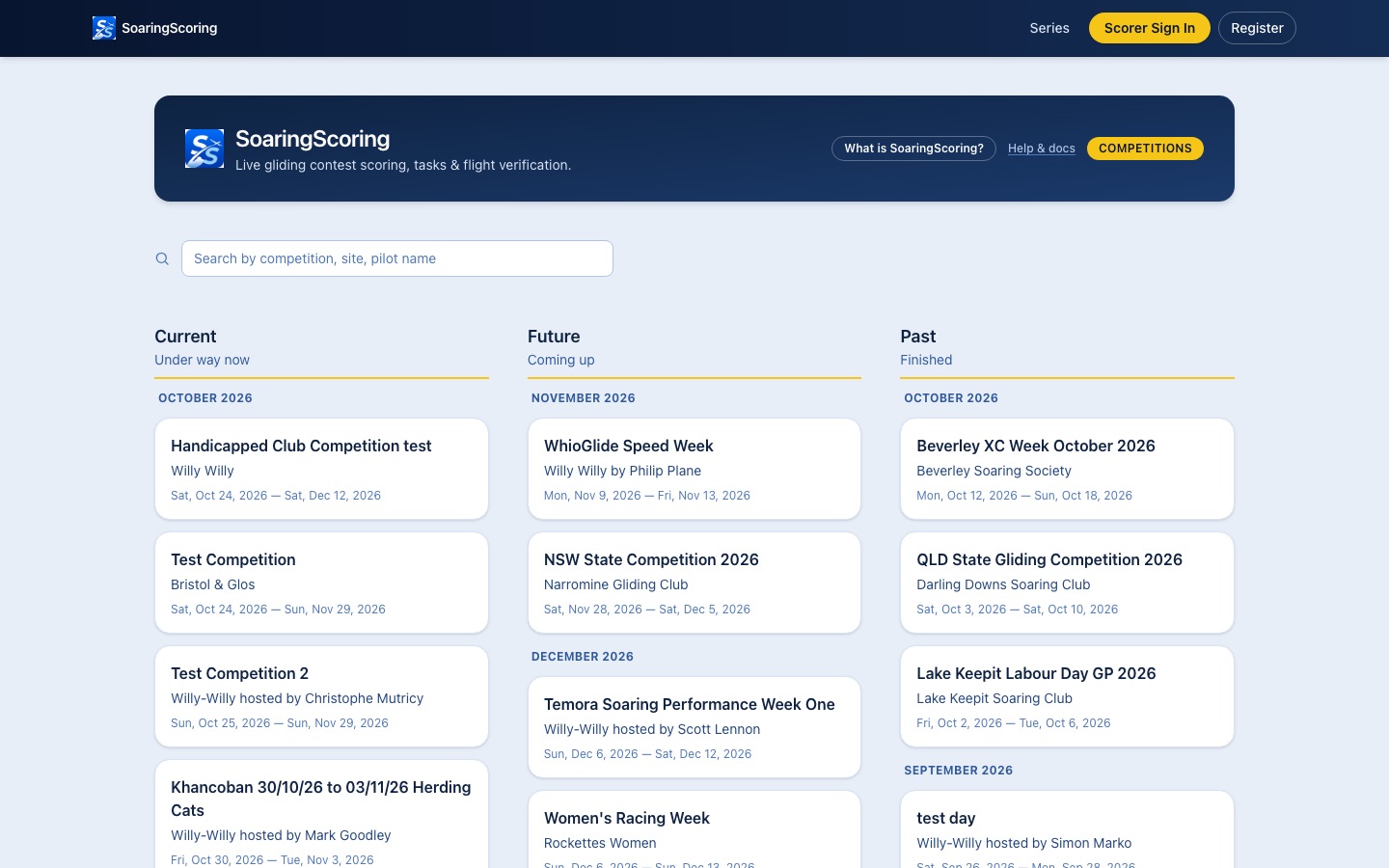
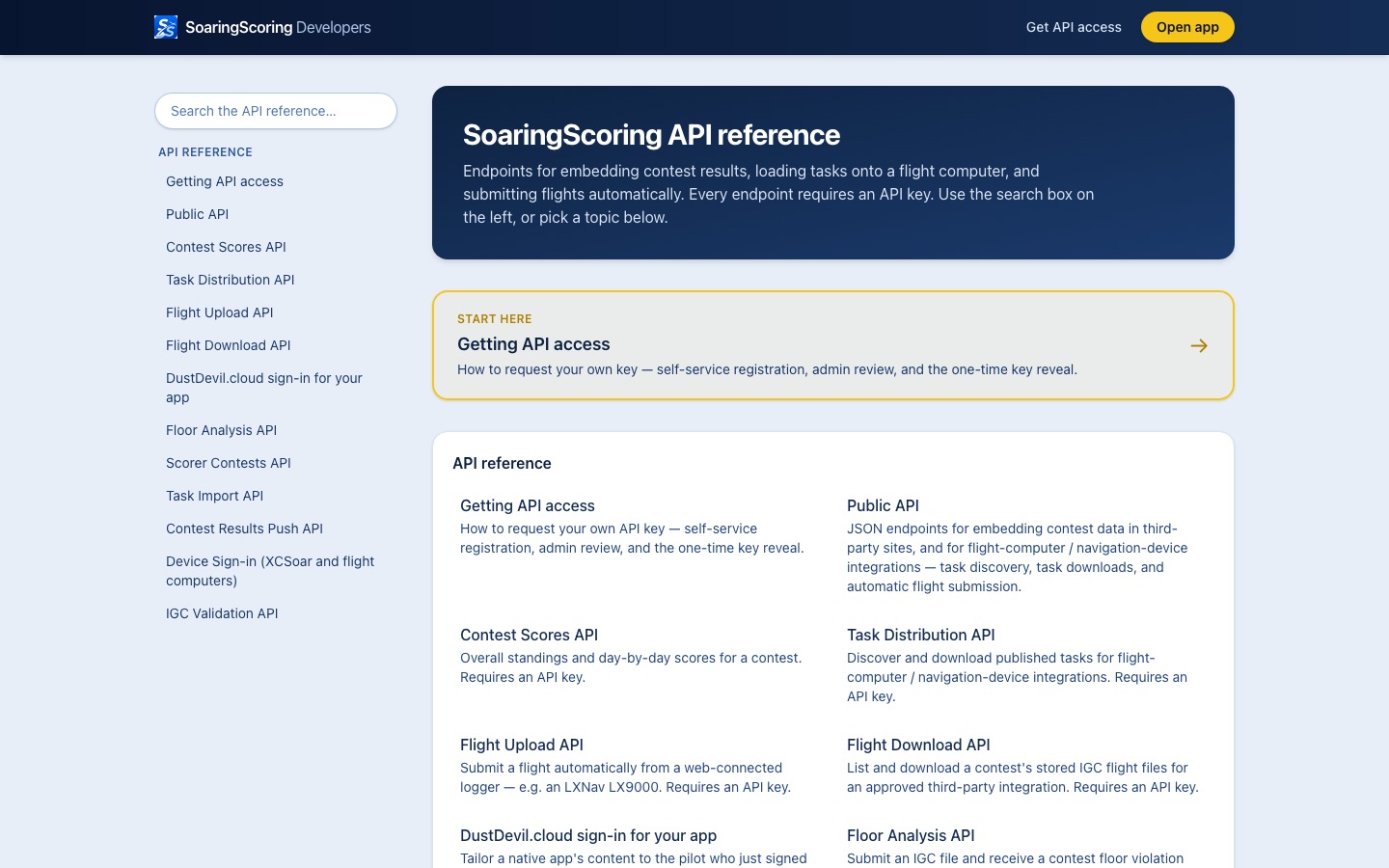
Scoring a gliding contest usually means desktop software, hand-built task files and late-night spreadsheet checks. SoaringScoring moves the whole workflow into the browser: organisers set racing, assigned-area (AAT) and distance-handicapped tasks on a map and export them to XCSoar and SeeYou, pilots' IGC flight logs are scored automatically, and public results pages include flight-trace analysis and replay. Companion sites cover documentation, live tracking from the OGN network, and how the scoring works. It is currently in pre-production, being tested against real Australian contests. The developer site at dev.soaringscoring.com documents the public API: contest scores, task distribution and flight upload endpoints for flight computers and navigation devices such as XCSoar and LXNav, API-key registration, IGC validation, and floor-violation analysis.
Under the hood
- Python on AWS Lambda
- Proximity-conflict analysis runs as an on-demand Python Lambda. It pulls a day's IGC files from S3 in parallel, parses and resamples every track to a 1 Hz grid, uses a spatial grid so only nearby glider pairs are compared, and writes the events to MongoDB. 60 gliders on 5-hour flights take 20 to 40 seconds.
- Safety officer tooling
- Scorers and safety officers review close encounters between gliders on a dedicated analysis page, alongside a FLARM performance check built from Open Glider Network data and contest floor-violation analysis.
- One-click safety summary videos
- After a safety officer has vetted the day's events (excluded ones are left out), the browser renders a safety summary video and, on a click, publishes it to YouTube. Each close encounter is replayed over map imagery, with the camera zooming in and slowing to the moment of closest approach, and floor violations show height above the terrain. Gliders stay anonymous in the video, and it's always published unlisted.
- Tested against real contests
- Each detector is checked against real contest flights. Head-on and blind-spot detection were retired after false positives, and opposite-direction thermalling is paused until it can be validated on a larger batch, so the safety page doesn't cry wolf.
- IGC security validation
- Flight logs are checked for tampering using each logger manufacturer's own G-record validators. Because those only run on Windows, the checks happen on an isolated worker that pulls jobs from a queue, and the verdict (validated, did not validate, no validator or error) is shown to scorers without ever changing scoring.
- Integrations and public API
- Single sign-on and partner APIs with DustDevil.cloud, with an S3 drop box as a fallback for pilot uploads. A scoped, API-key public API with an OpenAPI spec and the dev.soaringscoring.com reference. Scorers can give instructions by Telegram, which are interpreted, confirmed and applied. Pilots can submit flights by email, and public pages offer 3D flight replay.
Related sites